
In this essay I share a collection of recent [ August 2019] insights on what energizes me to violate and harm others. The insights coalesced as I processed having sexually assaulted a close friend and thus caused them very significant harm. I share these insights now partly as a contribution to the (still surprisingly sparse) experiential reports from people inside masculinity, and partly because I see my own interior processes shared by a large number of people assigned male.
As background about me - I was involved in men’s work and men’s community for 30 years before I transitioned. I was drawn to menswork by a collection of awakenings I had at the cusp of adulthood, as I realised that the deep isolation, disconnection and intense physical pain I was suffering were profoundly gendered. So “masculinity” has been “in question” for me since then.
I’m also motivated by a deep compassion towards men. My three brothers are warmly loving and my father was quiet and gentle. And through much trial and error I’ve found that the best fertilizer of the growth process is kindness - to all people but mostly importantly towards myself.
A credible threat of violence
Steven Pinker is a well-known evolutionary psychologist, adept at arguing that the Western binary gender order is an evolutionary necessity. The only part of his work that I value is his description of masculinity, which has so much traction I think because he wholeheartedly believes in it. He says the essence of masculinity is “the ability to convey a credible threat of violence.” This chimes perfectly with my experience: when I was unwilling to do this I was beaten up, ostracised, shamed or humiliated. It contextualises my alarming patterns of self-hatred and self-harm. And it contextualises my patterns of causing harm to others.
In order to manufacture this credible threat of violence people assigned male are socialised through a process I call “brutalisation”: learning body-level patterns that become our default way of being-in-the-world and our default response in most situations. As a very young child I learned that going along with the brutalisation process - becoming a willing subject in it - kept me safer than otherwise, and enabled me to be recognised as “male” by systems which make social goods readily available to “men”. In other words, although I had no choice to be the subject of brutality, I became motivated to actively encourage my own brutalisation. And the major features of this process were well embedded in me by the age of four.
Skin Hunger
Recently I’ve uncovered some core pieces of this brutalisation process in my own personal history.
The first piece emerged after I’d caused harm to a close friend through invasive touch. In examining what non-conscious forces prompted me to sexually assault them, I connected first with my desperation around touch. I recognise I have a traumatic form of skin hunger. The skin hunger started very soon after birth when I was abandoned in the neonatal ward - the common neonatal practice in the 1950s. Then my family of origin was not tactile. Although my mother was warm and loving she was also violent and emotionally abusive, so that loving touch was both unpredictable and emotionally costly. My brothers modelled themselves on my father: emotionally cool, intellectual and distant. When I was 2 I suffered betrayal by my brothers, who “dropped” me as an object of holding when my younger brother was born and they transferred their affections to him. Then I had no caring touch at all from about age 8 to 14 when I connected with my first girlfriend. The only touch of any sort I experienced in that time was being beaten up a few times at school.
I recognise now that my body responded to this lengthy period of absolutely no touch in childhood as if it was a trauma. When now as an adult I ask for touch or offer touch, when I hear “no” or even when I hear a modification to my request, I become triggered: I lose presence, freeze at a certain internal level and lose sensitivity on my skin and in my hands and arms. My emotional field shrinks, my mind dims and I am less able to connect. So in order to avoid this trauma-response around touch I simply don’t ask. Instead, I go ahead and touch - which is actually assault, and is what I did with my friend.
I’ve come to call this the skin-hunger triangle or the touch-trauma triangle: childhood touch-trauma means I get triggered around “no” to touch as an adult, leading me to take touch nonconsensually.
Here’s a picture of the triangle:

Danger
The second piece landed on the first morning of a weekend workshop. I arrived only just on time and almost all the other attendees were already there. Nearly all the other dozen people were assigned female, and all but one unknown to me. As I entered the room I could feel a frisson of tension and alertness sweep through the space. I read this wave of tension as alertness to danger.
Since transitioning to nonbinary I’d become more aware that I get read as powerful and therefore a potential danger. My first memory of this was age 13 when a mother holding the hand of her young child pulled the child away from me with the exhortation “Look out for the man!” (I was very tall for my age.) Also I myself frequently see “men” as a potential danger - I respond to some people presenting male with a frisson of wariness similar to those other attendees at that workshop. So when I am “read” as male, I am also “read” as “danger”.
I have internalised this story that I am dangerous - that I cannot be trusted around emotion, around sex, around any body-level things. I held a story that my bodily needs are dangerous, my desires are dangerous, and that if I let my needs and desires be present I ruin things for other people, and they are repelled and withdraw. As a result I held back very significant parts of me - in other words I colluded with this story and suppressed myself and held myself at a distance from others. Naturally, keeping myself distant prevented me from having important needs met.
Now the process of digesting my sexual assault of my friend had given me a new piece: here I had caused harm to my friend. My close circle were all impacted by the reality that I do indeed act in ways which are harmful to others. From Non Violent Communication is the idea that violent communication is simply “tragic expressions of unmet needs.” This is a wonderfully compassionate description of how things go badly wrong between people despite many good intentions. This compassionate viewpoint enabled me to see that I was socialised to meet core needs in ways which are harmful to others.
Initially this realisation was devastating. I felt trapped in a dreadful triangle: I am read by others as a danger, I carry the story I am a danger, and in practice I attempt to meet core needs in ways that are actually a danger. People are right to be wary of me - it’s all true!
This, then, is the second triangle, what I call the danger triangle.
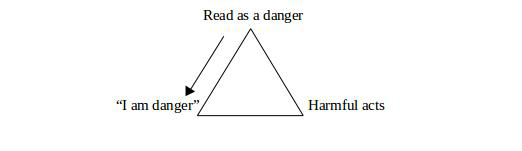
The Vortex
Now neither of these patterns are exclusive to those socialised into masculinity. Many people of all genders in Western countries experience deep and even traumatic skin-hunger - it is an artefact of the Modern-era theme of Individualism. Likewise, being a danger to others is a reality for some people socialised into femininity - my mother is an example.
Nor are these patterns present in every person assigned male. Some people assigned male do not have skin-hunger and continuously experience positive physical connections with others. And people assigned male also have ways to socially engage that are not part of that “danger” spectrum.
However here’s the third piece. These two triangles sit alongside each other within a broader culture i.e the heavily gendered context of Western patriarchy. For me personally and for many people socialised into masculinity they have an electrical power. I conceptualise this landscape thus:
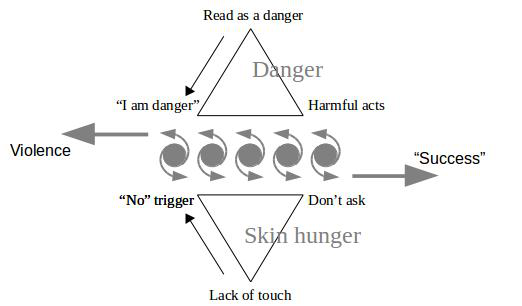
While these triangles are experienced personally (skin hunger) and interpersonally (danger), they also operate within a culture which intensely valorises them as legitimate and proper things for “men”. Boys should be brutalised and traumatised: exhortations to “man up”, avoid being “gay”, the moral panics around boys wearing dresses, the continued debate around circumcision. Harm-causing actions are richly rewarded with social goods: money, women, power, status.
The particular shape of the wider culture and the forces operating at a structural level in our society mean that the space where those two triangles juxtapose is like a vortex. My very ordinary middle class white boyhood was riven with very ordinary violation and brutality. As I grew up and mastered the acceptable masculinity patterns I felt a sense of freedom as less violence came my way. As a young adult I felt success as others, including powerful men, congratulated me on “achievements” and I attracted women partners. I was swept along by the positive affirmations I received from the world around me. At the same time, the violence was always hovering at the edges, ready to pounce whenever I did unacceptable things.
People not assigned male at birth or who are not read as male very seldom experience this vortex. Women with skin hunger might also, like me, “not ask”, and are commonly condemned as sluts. Women who push and shove, or who are simply mildly assertive, are frequently ostracised as unacceptably violent.
For people read as male the power of the vortex is intense. The combination of intense violence in one direction and widespread celebration in another direction is pretty much unavoidable. Parents are constantly affirmed in their gendered patterning. Even boys raised in enlightened or radical settings, by parents seeking to resist the violence, are deeply impacted by the cultural soup and the institutional structures that shape their lives beyond family.
Internal experience obscured
The intensity of this vortex seems to also obscure the internal mechanisms of masculinity - what it is like to subjectively experience these formations from the inside. It is as though only men’s actions are sucked through the vortex while the internalised brutalisation which shapes them is stripped off. The psychopathy which is celebrated as a pathway to success, fame and fortune in the corporate world is immensely difficult to see as common trauma-response because the violence which evoked the original trauma is so thoroughly normalised. The romance trope of the heroine falling in love once the hero overcomes her resistance not only normalises rape. It also obscures how his hero “strength” depends on his projection of all his emotionality, sensuality, vulnerability and sexuality onto her.
There is of course a counter-discourse that critiques and rejects this intense valorisation - which I have been deeply involved in since my entry into adulthood. But even that discourse struggles to piece together how all this stuff comes about within the individual male psyche. For me, having spent half a century inside masculinity, ideas like homophobia and entitlement are only effective in describing the outward actions of men. These (very helpful) terms have been coined by those subject to men’s actions. But they go nowhere near describing or encapsulating the interior processes which energize the patterns of action that are called “homophobia” and “entitlement” - the intensity of the violence from which these patterns are propagated. As a result there is still very limited understanding of why men continue to rape or violate, how that comes to be a doable thing for many men, a possible pathway to meeting needs.
A very personal example for me is the issue of violence on the street. The street is often seen as a space which straight white cis men legitimately occupy while “others” - women, gay and trans people - are at risk of danger. My experience of the space of the street is that it is a space of violence for everyone. Certinly, it is policed by men, and I can be “safe” there when I do “man”. In other words my technique for traversing that space is to collude with the inevitability of violence by policing myself to never reveal the aspects of me that survived my masculinity brutalisation. To put it another way, my safest option is to “convey a credible threat of violence”.
It seems immensely difficult to see the internal workings of this process, to see the extent to which men police themselves, i.e. actually perform violence on themselves, because this violence is so thoroughly normalised. To me the entire public space - not just the street but all aspects of public life including the workplace, the political sphere, the commercial world, the media, and the online world - is foundationally structured by violence. And this violence also foundationally structures our collective social relationships with non-Western societies and the non-human world.
In short, Western culture is predicated upon normalised violence. And those occupying masculinity, i.e. those occupying the Western norm of what it is to be a person, have the most intimate relationship with this normalised violence. “Men” are the subjects of violence par excellence: the primary inheritors of violence, the primary sufferers of violence, the primary propagators of violence, the primary policers of violence, the primary beneficiaries of violence.
Personal Resolution
For me personally, I am unpicking how that normalised violence “got in” to me in the first place, where it “sticks” or is anchored, and then where it comes out of me in day to day life. The traumas of my childhood were themselves completely normal for middle class suburbia. My neonatal abandonment was mandated as best practice. My parents were only ever acceptably violent. I was never hospitalised from the violence at school. The years of no touch went unnoticed precisely because it was so normal.
At the same time, I was being slowly shepherded by those around me towards being a man, and inducted into the world of men. The distance which opened up between me and others perfectly fitted my inner stories and the world around me, so that the pain and anguish I suffered appeared to be a personal failing, and nothing to do with my socialisation or the shape of the social world. The flat grey plain which was my emotional world at the cusp of adulthood drove me towards seeking satisfactions in gendered and culturally mandated ways: damaging the natural environment, self-harm through overwork, aspirations to wealth, and displacing my needs for touch, emotional expression and care onto women. All these things were deeply important to me, so important that I became a danger to others: I would fight with people who tried to prevent me having them.
And all of these things were celebrated by those around me - celebrated for me and celebrated in the lives of others. I had a good middle class hippy life - I was liked and, I think, respected (mostly), I did OK with generating money and in business, I had charming and likeable partners, I was suitably left-wing and radical. The world received me as a man and affirmed that the masculinity socialisation worked. The vortex carried me along.
But more than this - far, far deeper than this. These patterns of violence are deeply embedded in my limbic system. The most intense traumas occurred by the age of four, well before change-of-teeth when the limbic system’s development ceases. The long-term trauma of skin-hunger which ran into my teens cemented some of the early traumas. As a result, violence in the form of violation of others remains one of my two familiar go-to responses. (the other fave is “going to my head”: retreating to an emotionally shut down intellect-only engagement - which some people say is also emotional violence to those in connection with me.) When I am intensely stressed, or in a moment of shocked surprise, when I am triggered, or deeply exhausted, my limbic system kicks in. It does its job of moving me towards mammalian safety in the ways that were firm-wired in it when I was a child.
Alongside feeling trapped in the triangle of danger was also a feeling of relief. Being able to own that I was socialised to rape, to invade and to objectify enables me to also own that it is inevitable that I will violate others - not because I intend to or believe that is legitimate but simply because violation is deeply entwined in me with core needs, and sometimes my new tools get overrun by that deep entwining.
And through a lot of loving kindness from close friends, through community that affirms and holds me, and especially through a healing connection with the close friend who I had assaulted, I might be opening pathways to being safe - which is a story for another time.
An engine of masculinity
When I sexually assaulted a close friend I had to come to terms with what drove me.